Everyone once in a while, some low-brow food can be really, really yummy. I guess “low-brow food” is a cousin to comfort food. It’s relatively easy to make, uses mostly basic ingredients, and it’s common to the people—the opposite of abeaujiedish, like duck confit.
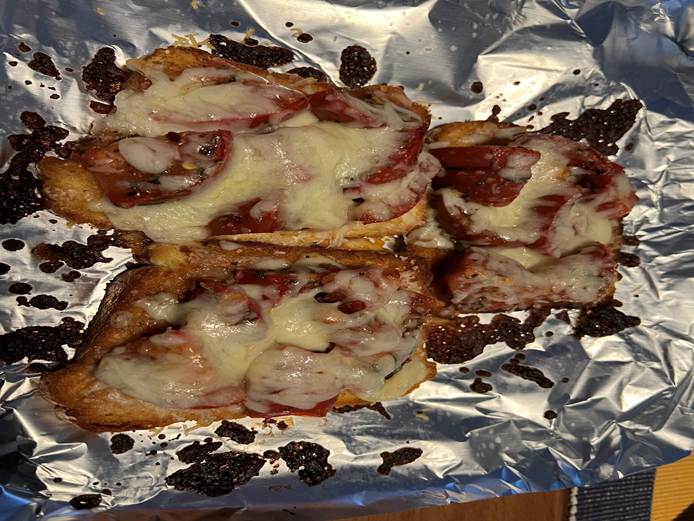
The other day my neighbor, a master gardener, off-loaded a bag full of San Marzano tomatoes to me. This being September, every gardener in the Western World has ripe tomatoes. And they grow in bunches! Unsure of what to do with my good fortune, I poured myself a drink and thought about it. And it wasn’t long before I came up with it: pizza toast!
I had some chicken thighs I was going to roast for dinner and have with an arugula salad. I thought this would make a fine weeknight meal, and I was quite right!
I diced the tomatoes, drained off most of the liquid and seeds, then tossed them with truffle oil, minced garlic, dried basil, dried parsley, a pinch of red pepper flake, salt and pepper, and toasted slices of homemade bread my sister gave me. Since the tomato concoction was pretty wet, after toasting the bread I laid down a layer of finely grated Parmesan cheese, then piled the tomato mix on top, and applied a generous handful of shredded Mozzarella before tossing the slices in the oven. Man alive it was good!
For wine, in my cellar I came across a 2022 Micho blend from Daou winery in Paso Robles. I have long been a fan of Paso wines, and this one did not disappoint. At all. My cousin and I traded wines a while back – he got some Sonoma juice, I got some Paso juice, and this was one of the wines he had left at my house. The wine is a Bordeaux-style blend created in honor of Georges and Daniel Daou’s sister, Michelle. It is 63% Merlot and 37% Cabernet Sauvignon. Having spent the better part of a week this last summer in Bordeaux, this wine would certainly compete with anything I drank while touring the Right Bank around Saint-Émilion, for sure.
While the concept of “it takes a village” was originally used to describe raising a child, it has since broadened to mean a shared effort involving support from a larger community. Yet here it was a Thursday night, and I made something delicious to eat that was directly connected to my neighbor, my sister, and my cousin. Beyond the satisfaction and nourishment of the meal, it felt good to be part of something greater than just me, myself, I. It felt really good.
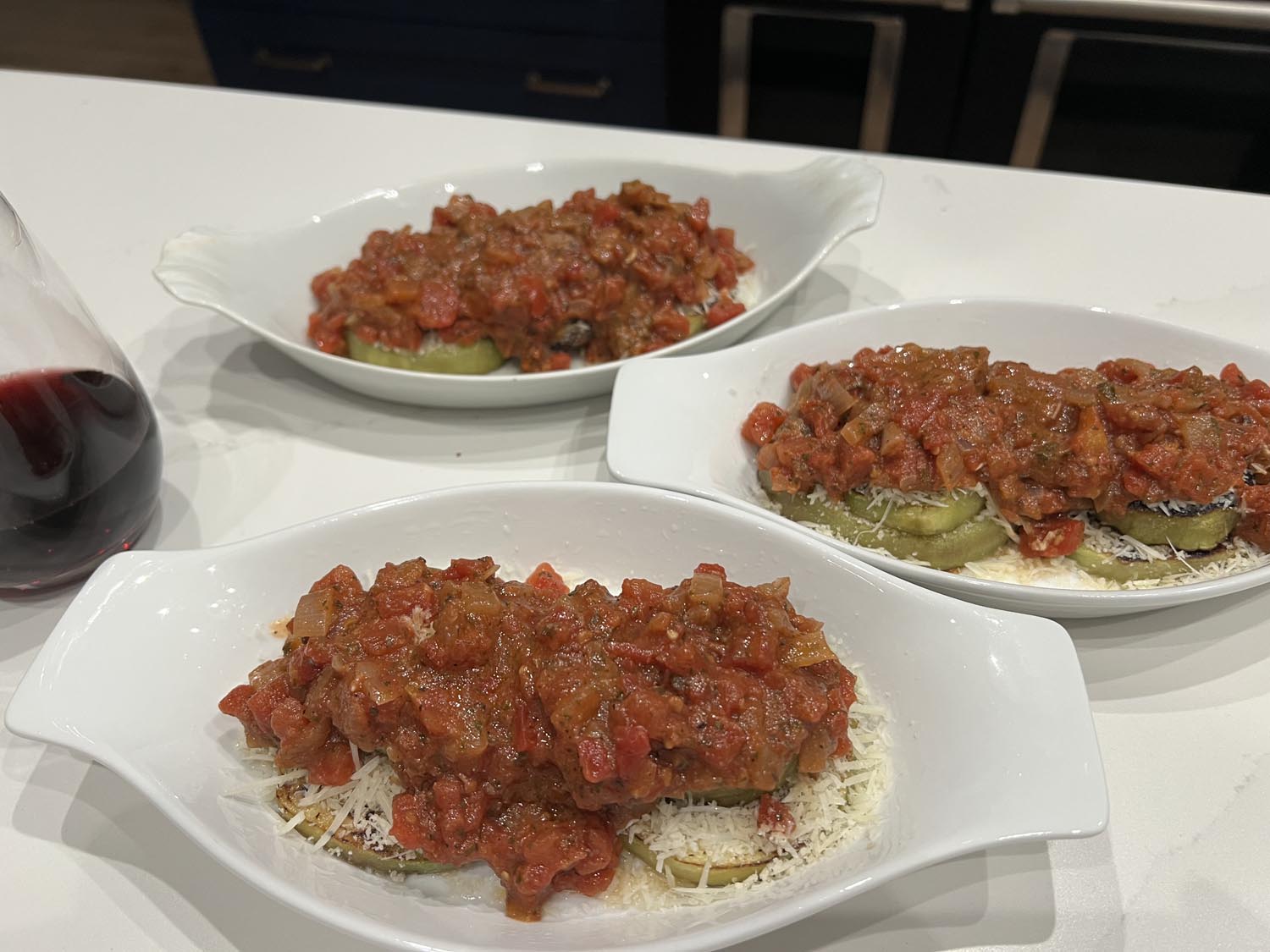
After my divorce, I went a few years without making eggplant parmesan, something that I enjoy periodically though not frequently. The reason for the dishes’ absence, of course, was the new girlfriend didn’t eat eggplant. That’s how it is for people. We like some things, others not so much, while some foods there is a red line, or hard no.
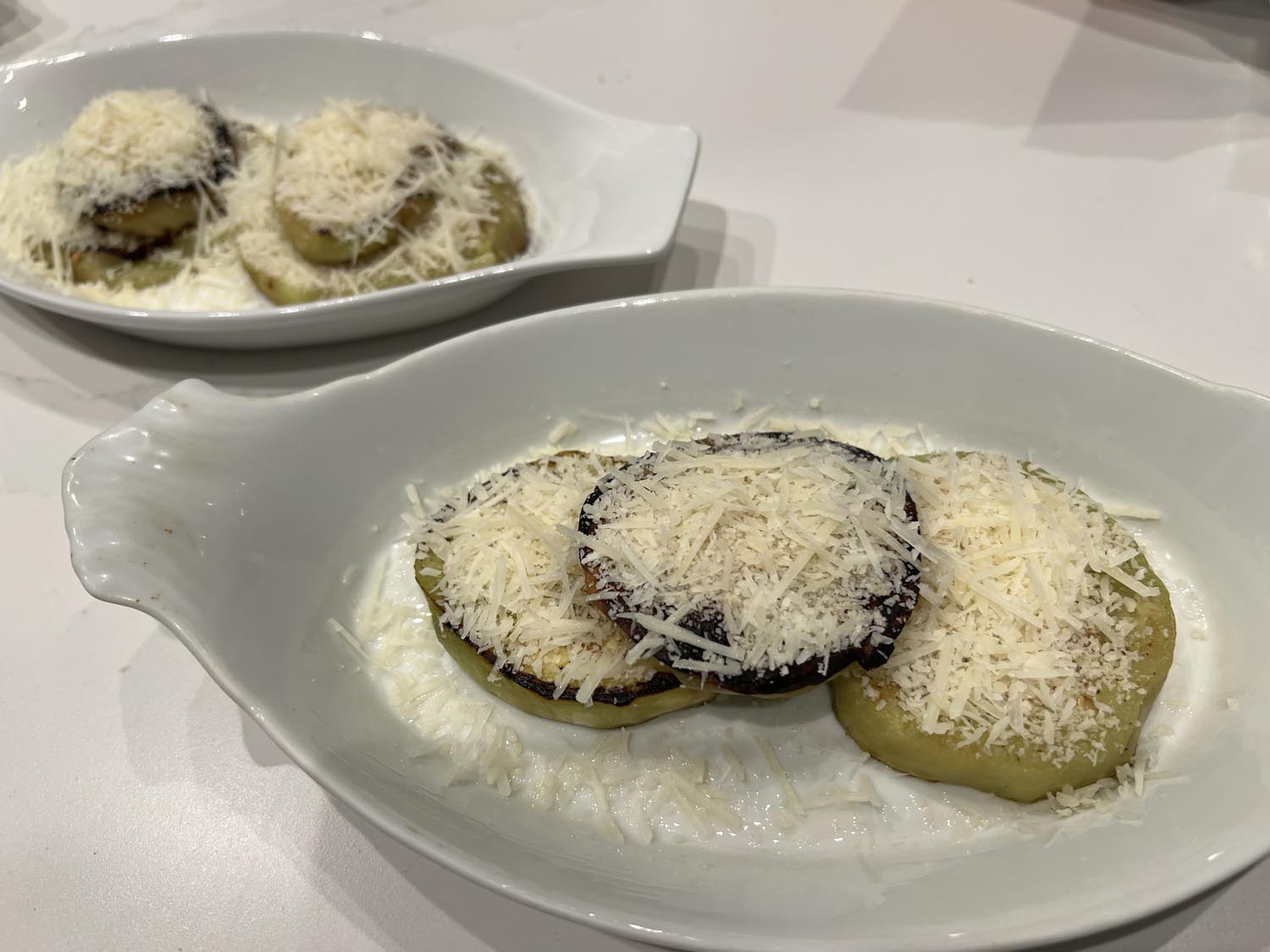
The hardest part about making eggplant is removing the skin. I use a potato peeler. Once that is done, slice the eggplant(s) in half-inch rounds, and lay them on sheets of paper towels. Salt both sides generously and then ignore the eggplant slices for about 30 minutes. This removes some of the water from the vegetable.
Fry the eggplant in olive oil in a non-stick skillet or pan in batches at a time, 3-4 minutes per side. You will need to add olive oil, most likely, as you turn the slices over and cook the second side. And more olive oil for subsequent batches until all the eggplant is fried.
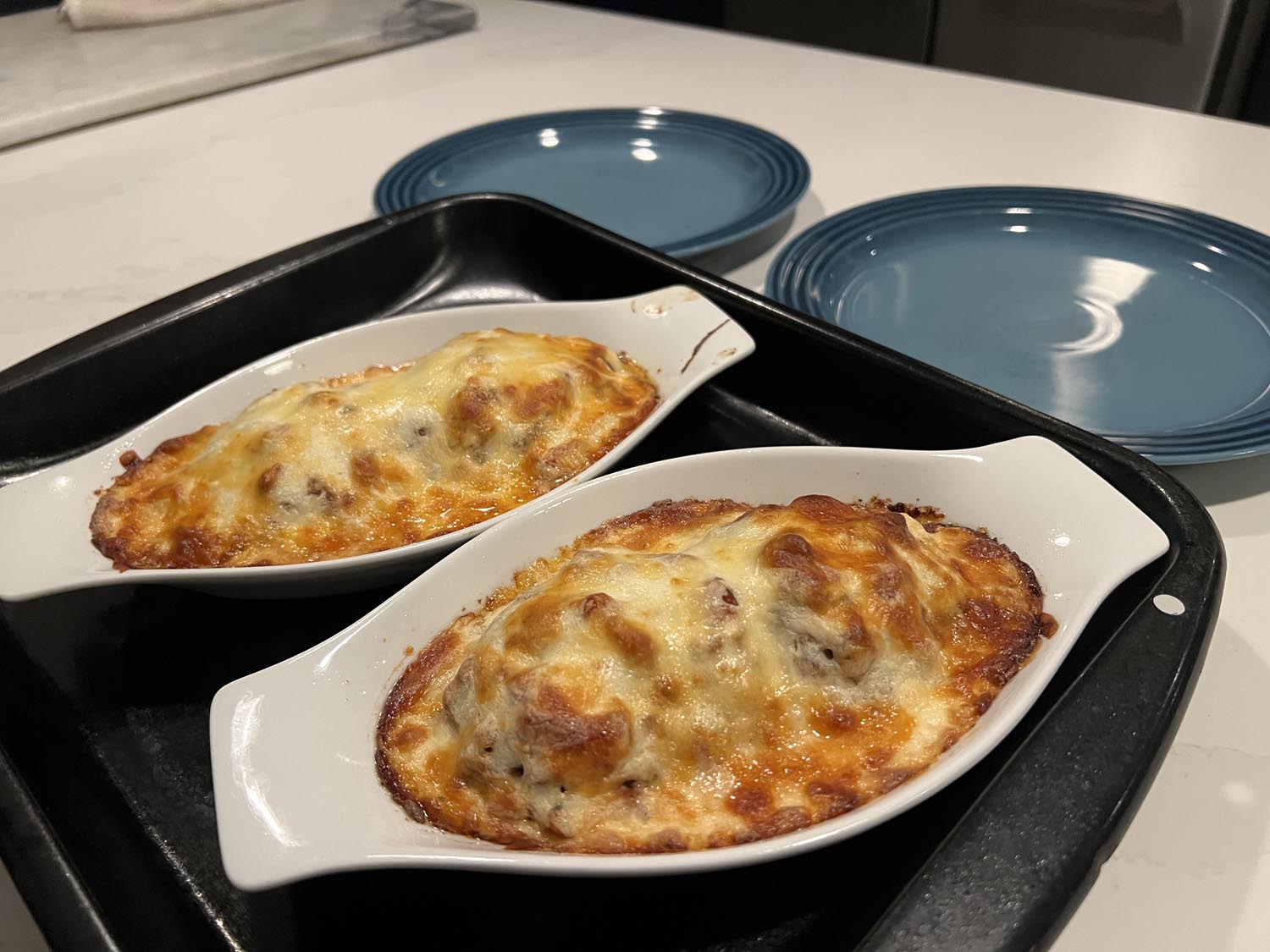
In a greased baking dish – or baking dishes, lay down the eggplant slices, then top with a bread crumb, panko combination. This will give the dish some support for the sauces to follow.
Then top the eggplant with parmesan cheese. And because I like the creamy texture of mozzarella, I will add some shredded mozzarella to the top.
Once that is set up, top the eggplant with a few healthy spoons of homemade tomato gravy (aka sauce to most Americans).
The third and final step before baking the dish(es) is to make a bechamel sauce using butter (roux), flour, a little grated parmesan cheese and half-and-half, until the mixture is creamy and begins to thicken, but not too thick.
Pour and scrape the bechamel sauce evenly on top of the eggplant slices with piles of tomato sauce.
About an hour into making my latest batch of Italian gravy, I could not help by think: Mom is smiling right now.” My house was smelling so good!
I needed to make a batch of gravy because I am planning my next dinner party – a Table for 6 (one per month – non-travel months, in 2026) and pizza is on the menu to go along with Tuscan-grilled New York Strip Steaks and roasted fennel with lemon, butter and parmesan cheese, and am out of pizza sauce.
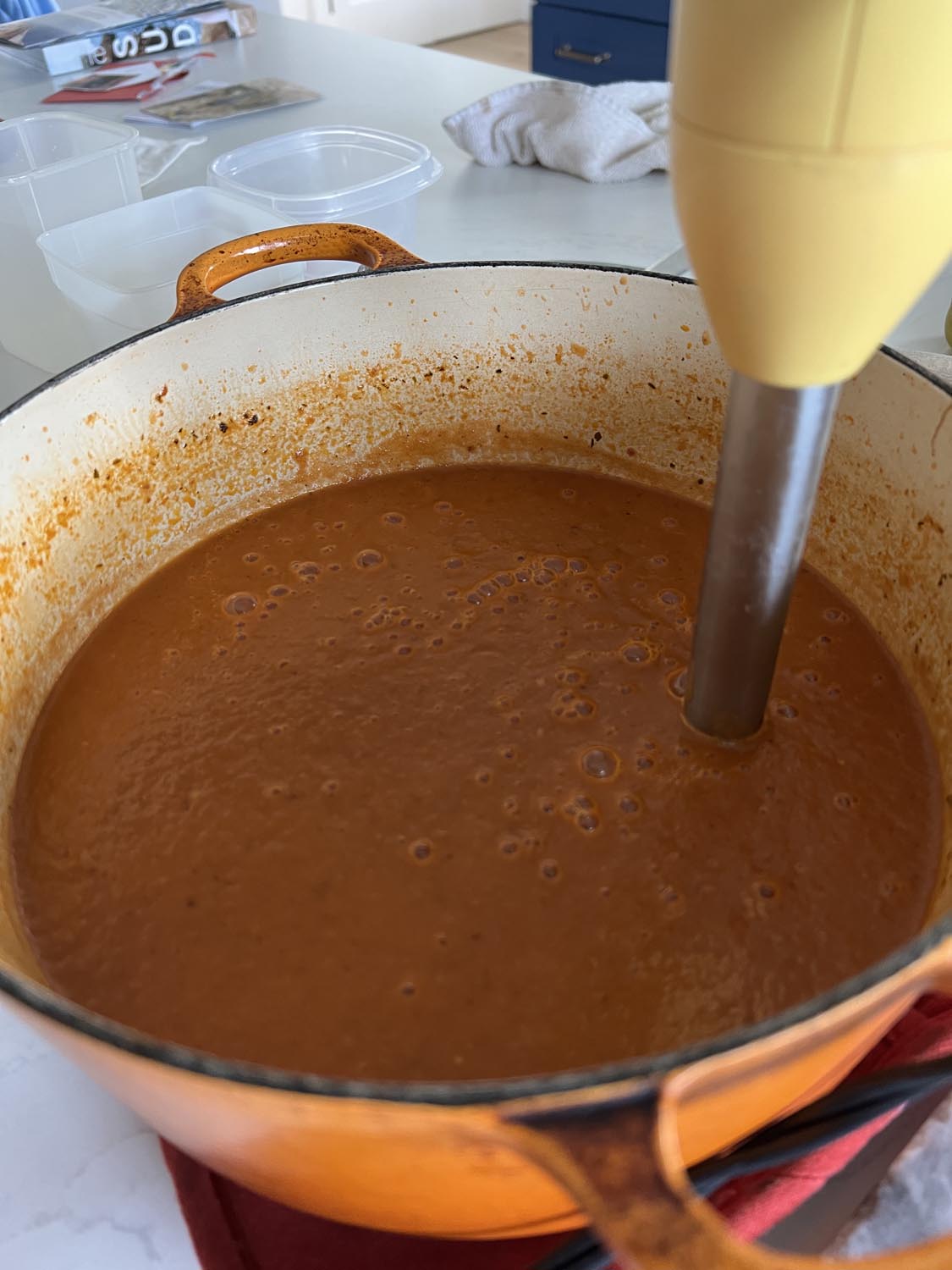
My pizza sauce is simply Italian red gravy, with an inversion blender inserted into the pot to make the gravy into a smooth sauce.
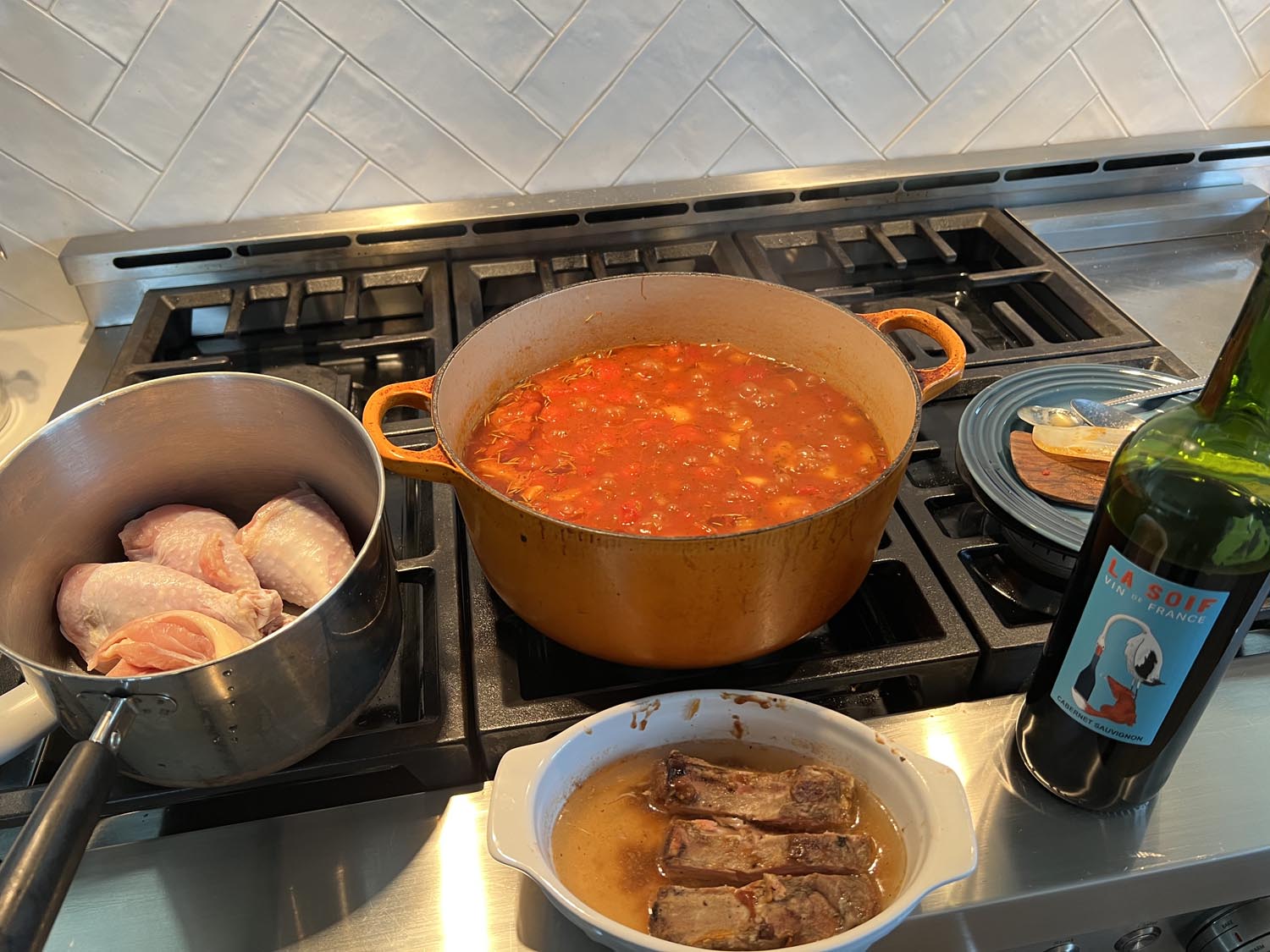
The photo shows the gravy when all the vegetables, tomatoes, chicken stockand wine has been added, and about to receive the meats – in this case chicken and a few pork rib bones. The upside to this: I now have a nice serving of gravy in the freezer for a future pasta dish, several containers of pizza sauce for future pizzas, including the two that I will make for Valentines’ Day and the aforementioned dinner for 6, and this Sunday I will have a fine chicken cacciatore with pasta dish to share with a friend.
The meats, meanwhile, give both the gravy and sauce a flavor profile sought after by home cooks throughout Southern Italy.
In a 4- or 5-quart pot:
Lay down a generous amount of premium olive oil
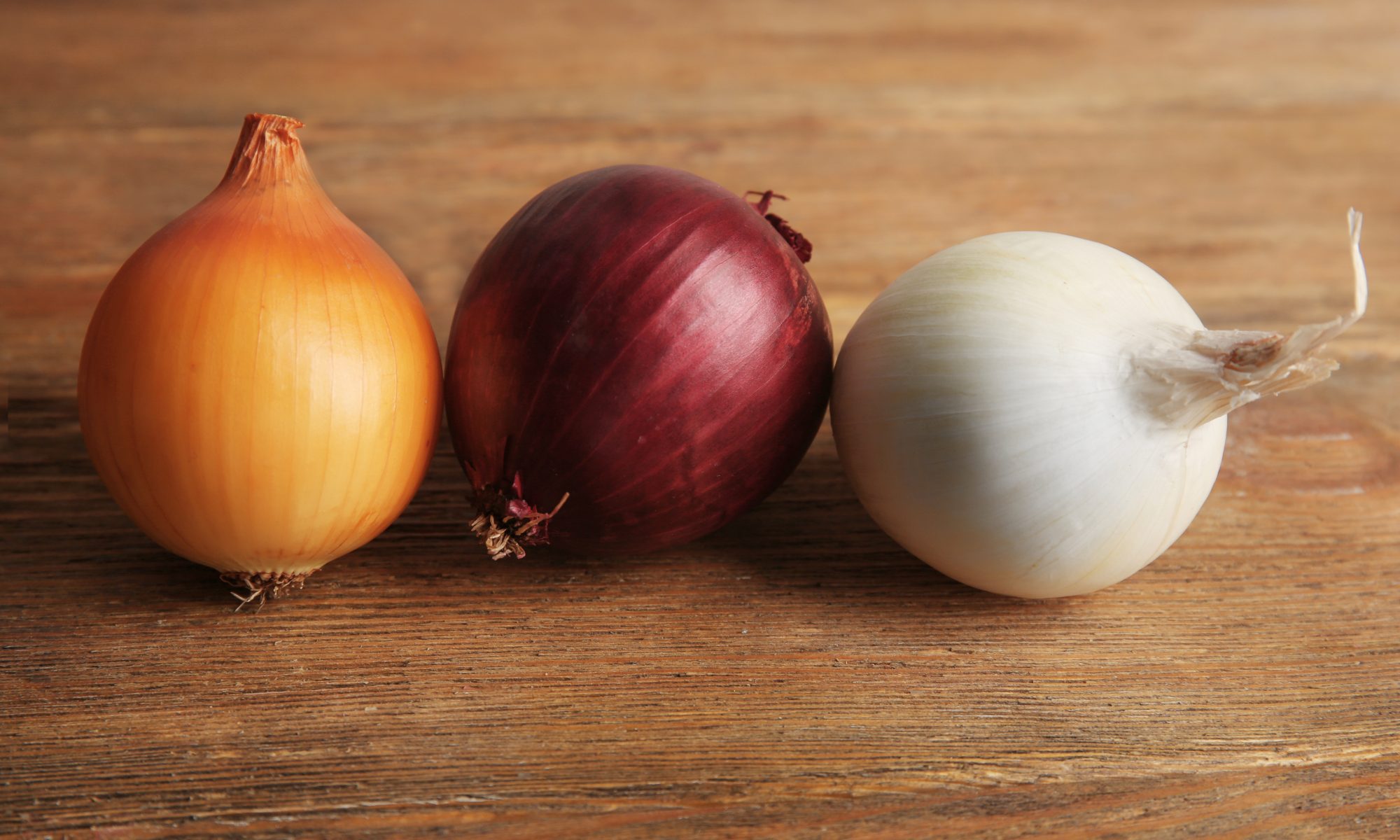
A Large, yellow onion, chopped coarsely
2 sticks celery
12 or so garlic cloves, coarsely chopped
1 large can diced tomatoes (16 or more ounces)
1 average can (15 oz) tomato sauce
2 heaping tablespoons tomato paste
A full teaspoon each dried basil, parsley plus black pepper, a little rosemary, Italian Seasoning if you have it.
2 full Tbls good salt
1 teaspoon sugar
1.5 cups red wine (for the gravy, but you can drink what’s left in the bottle!)
1 cup chicken stock
1 full Tbls duck fat, or 1.5 inches of a butter stick if you don’t have the duck fat
Sauté the onions, garlic and celery on a medium heat until soft – don’t char or brown the onions
Add the tomato paste to the middle/bottom of the vegetables and top that with the sugar. Stir to blend the paste with the vegetables.
Then integrate the cans of tomatoes, and all the spices. Stir well and let cook for about 5 minutes before adding the wine and chicken stock.
Once that is all blended together add the duck fat or butter, and then the meats.
Cover and cook on very slow heat.
After about 40 minutes remove the chicken and ribs. Set these aside to have as a pasta dish (chicken cacciatore) with some of the gravy after it is finished cooking. Refrigerate until you want this meal.
Let the gravy cook, lid on, slowly, another 2 hours or so. Remove from stovetop and let cook with the lid off.
Once cool, ladle out about half of the mixture to use with the vegetables still mostly intact as the basis for pasta dishes, and use an inversion blender to smooth out the rest of it to use as pizza sauce.
Hmmm. Multiple posts featuring grilled New York strip steak. Dear reader, I hope I don’t lose you to boredom.
Then again, my carnivorous audience will not only read, but celebrate!
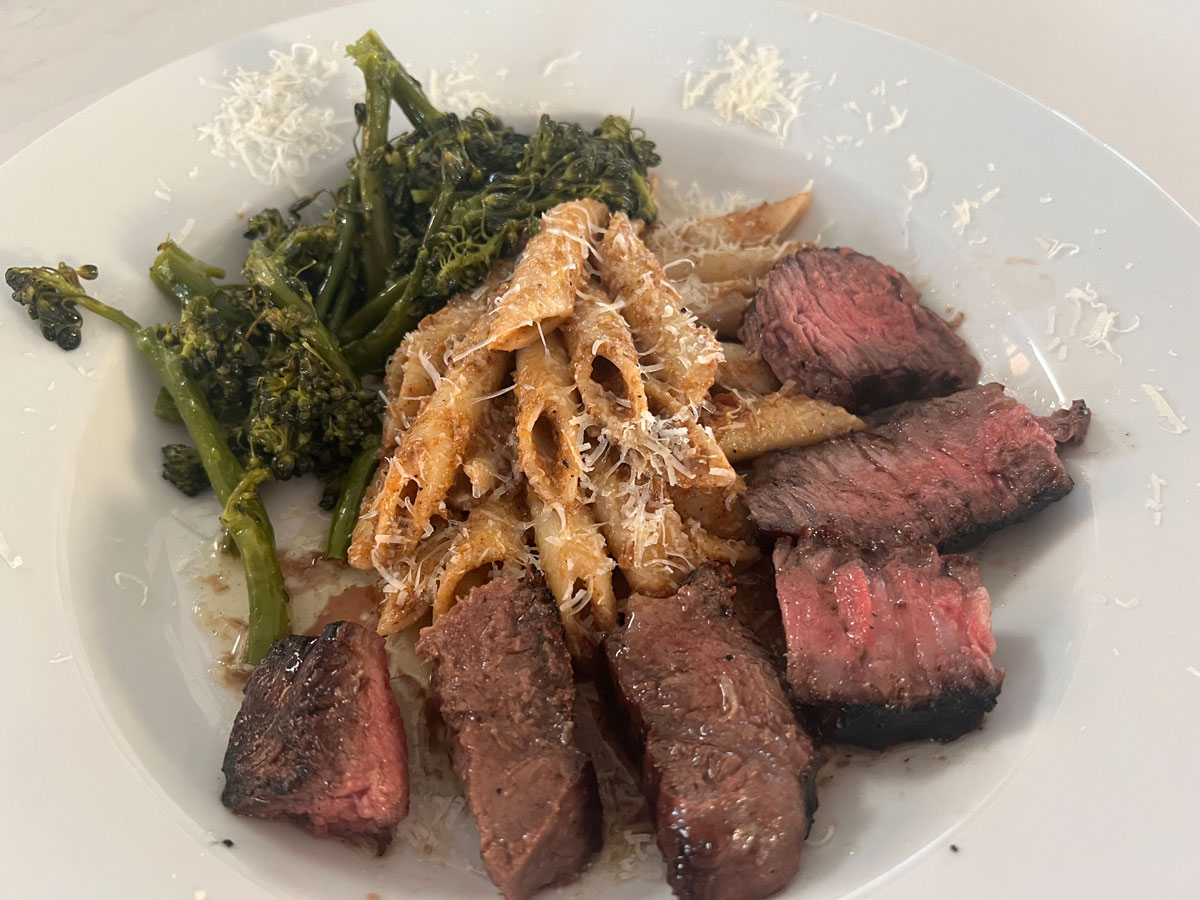
I typically only eat premium steaks once or twice a month. But it being summer and all, the grill beckons. So instead of roasted potatoes and Caesar salad, enter penne pasta, and broccolini.
For the sauce, in a 2 or 3 quarter pot, I sautéed onion and garlic in good olive oil, added tomato paste, a few pinches of sugar, then minced fennel, and a cup or so of chopped tomatoes from a can with its juices. And importantly, three heaping tablespoons of black truffle sauce from Urbani Truffles in New York.
Season the sauce with salt, black pepper, and dried parsley and basil.
Once that all came together nicely, I added a half cup of homemade chicken stock and a cup of red wine. Covered, and let it simmer on low for about an hour. Then I turned the stove top off, removed he lid to the pot and let it cool for 30 minutes.
Then inserted an inversion blender and made sauce of the mixture. Careful with the inversion blender! I do this on the counter (easier to wipe down than the stove) and also wear an apron! Trust, I have had sauces splatter my clean white T-shirt before.
I made the sauce a couple days before the meal, then heated it up to pour over the cooked and drained pasta.
For the broccolini, steamed, then sautéed in olive oil, garlic, red pepper flake. And salt.
If I were in Italy, no doubt this meal would have gone down nicely with a Super Tuscan, which is a Sangiovese-based blend and typically robust and perfectly dry for such a meal. Instead, we drank a delightful 2018 Petit Verdot from nearby Lambert Bridge. Petit Verdot, as many know, is typically found as a blend in Bordeaux blends, and usually in small percentages, like 5% to 10%. After this meal, and with that wine, I couldn’t help but wonder why we don’t see more Petit Verdot bottles on the shelves of notable wine purveyors. It was a very fine meal and pairing.
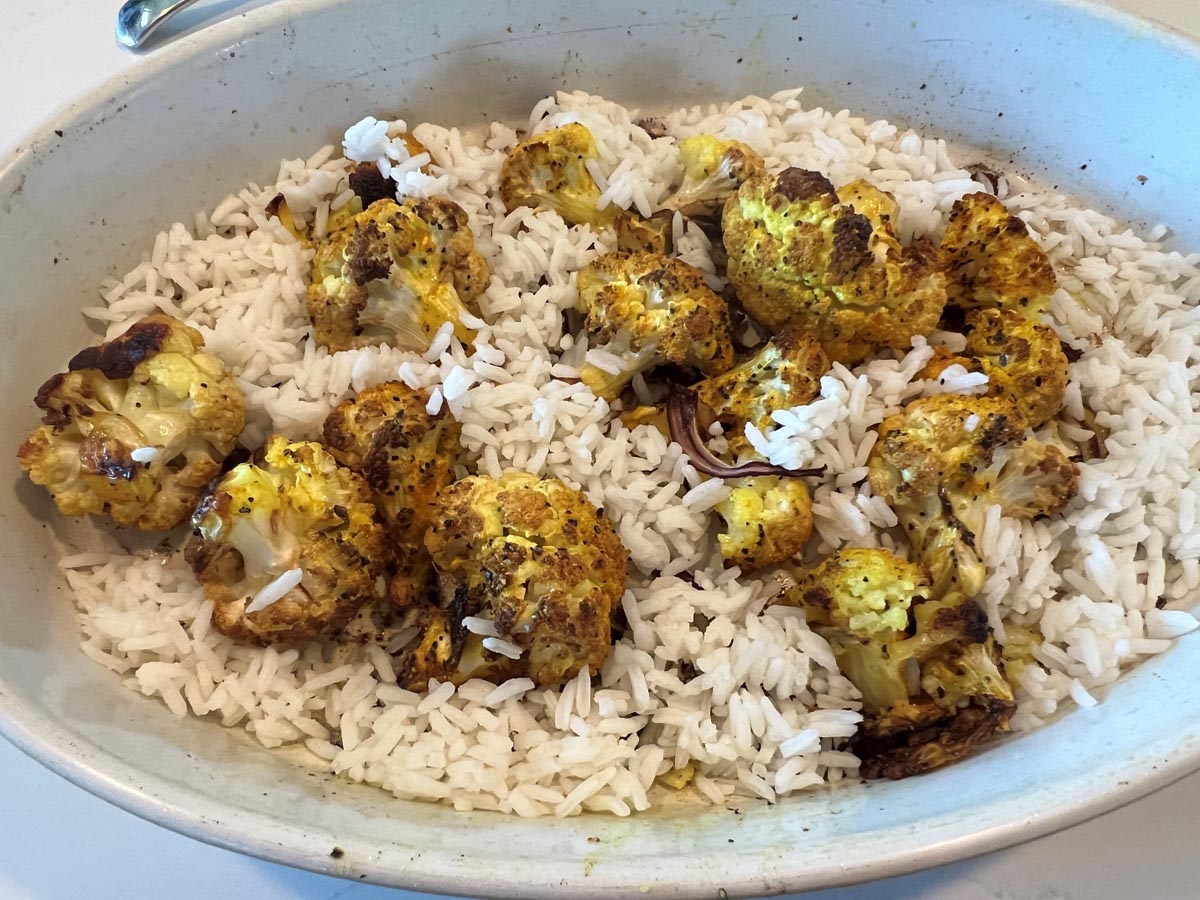
Here’s a great side dish with bling: roasted cauliflower and rice, finished with lemon juice, capers and a light amount of cheese. If you love lamb chops, that’s your protein. If you prefer pork chops, that’s your meal.
I’ve named this dish ‘Summer Cruise’ for two reasons. I will serve it in a ceramic boat—plus, it will feature bright flavorings that my active imagination believes would pair well with salty, sea breezes, as if you are on a small cruise ship or sailboat among friends, somewhere in the Caribbean or perhaps French Polynesia, where the famous, Post-Impressionist painter, Paul Gauguin, spent a significant part of his life. If you are reading this Mr. Vernon Minor, my Humanities Art 101 teacher in Boulder, I hope this brings a smile. I have not forgotton! In truth, part of my memory of Ganguin is because a very influential book I read, also during my youth, is largely set in Tahiti (also in French Polynesia), The Moon and Sixpence, by Somerset Maugham. I absolutely loved Maugham’s written command of English. His subject matter only enhanced the book’s appeal to me, a fanciful young traveler and adventure seeker, as Maugham traveled to Tahiti in 1917 for research, noting the blend of English, American and French influences.
For cooking:
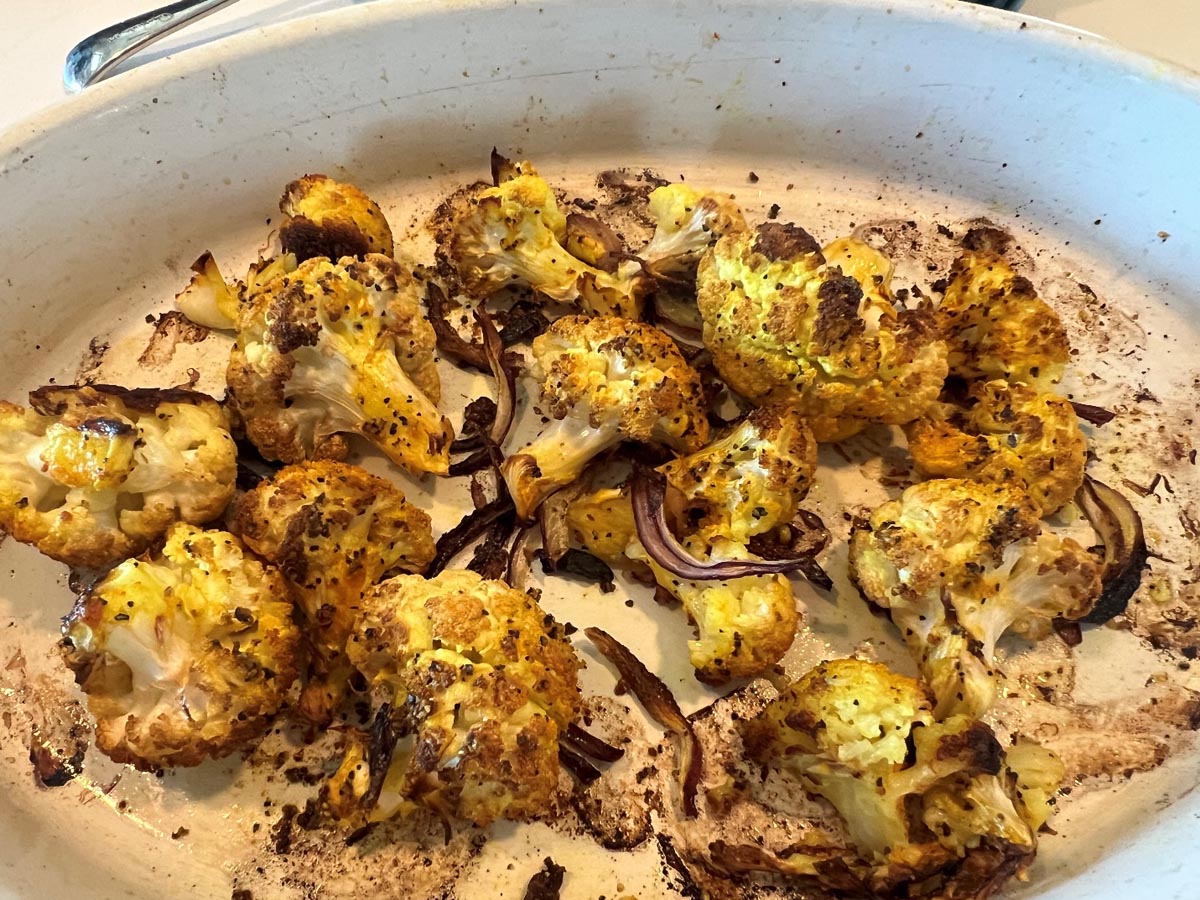
Break up or cut a whole head of cauliflower. In a mixing bowl, place the cauliflower then sprinkle with olive oil, salt, pepper, tumerick, sliced red onion, and toss around that place into a baking dish.
Bake at 425 for 35 minutes until golden brown. Remove.
Add the rice, bake in oven another 10 minutes or so until some of the rice starts to crisp up. Before adding the rice, I removed the burnt red onion but left the pieces that were not too charred.
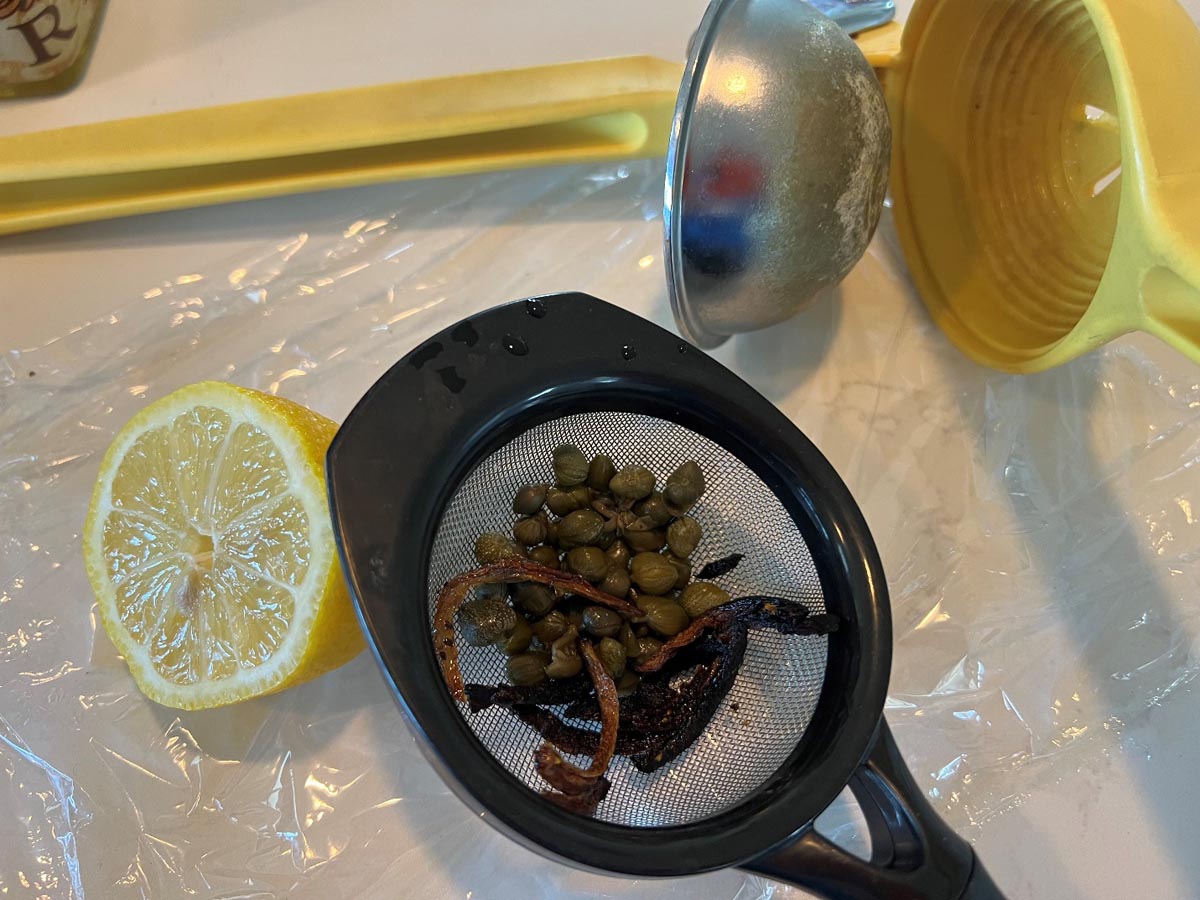
Once the veggie and rice is out of the oven, spoon in a small amount of RINSED capers, and squeeze half a lemon all over the dish.
Then top the dish with finely shredded parmesan and roughly shredded mozarella. Not too much, as this isn’t a cheese dish (but everything goes better with some melted cheese).
Please in ‘boats’ that were greased on the bottom, first, with peanut oil (for ease of cleaning).
To reheat before serving, I just use the microwave.
For wine, we drank a 2022 Full Boar Red from Eberle, which is Paso Robles based. For more on the winery founder, see the April 2024 post in www.blisteredonions.com.
This Full Boar Red is a new staple in my cellar. Sooooooooooooo drinkable, yet full bodied, and so affordable! At under $35, it’s a bargain. Here’s how Eberle describes it.
Full Boar Red is a Grenache blend that harmonizes the luscious flavors of black cherry cola and blackberry with the velvety embrace of cocoa powder. Let the alluring undertones of sweet leafy tobacco and exotic hint of cardamom transport you to a place of sensory bliss. This wine promises a symphony of flavors that dance across the palate, weaving a tapestry of complexity and indulgence.
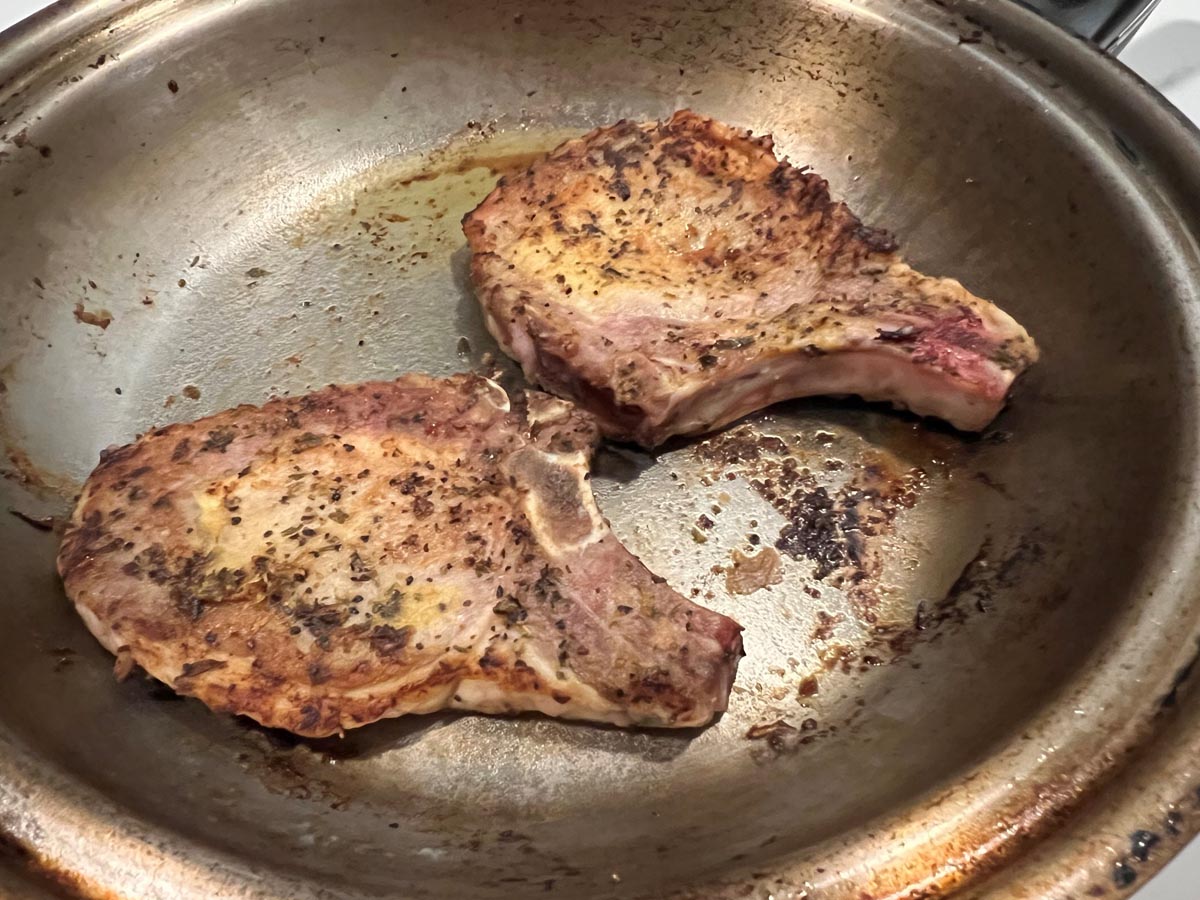
There are many merits to pork chops: taste, ease of prep, affordability, and very short cooking time. In fact, it may take longer than all those steps combined, just to clean the stainless skillet. But like divorces can be expensive, it’s worth it!
After making the roasted cauliflower dish and telling my sister about it, and suggesting pork chops or lamb chops to go with the vegetable and rice dish, my sibling asked me how I do pork chops. Here goes.
I buy thin, bone-in chops from my butcher. I suppose a thicker chop would work, but they can finish on the dry side, given the added cook time to finish the meat.
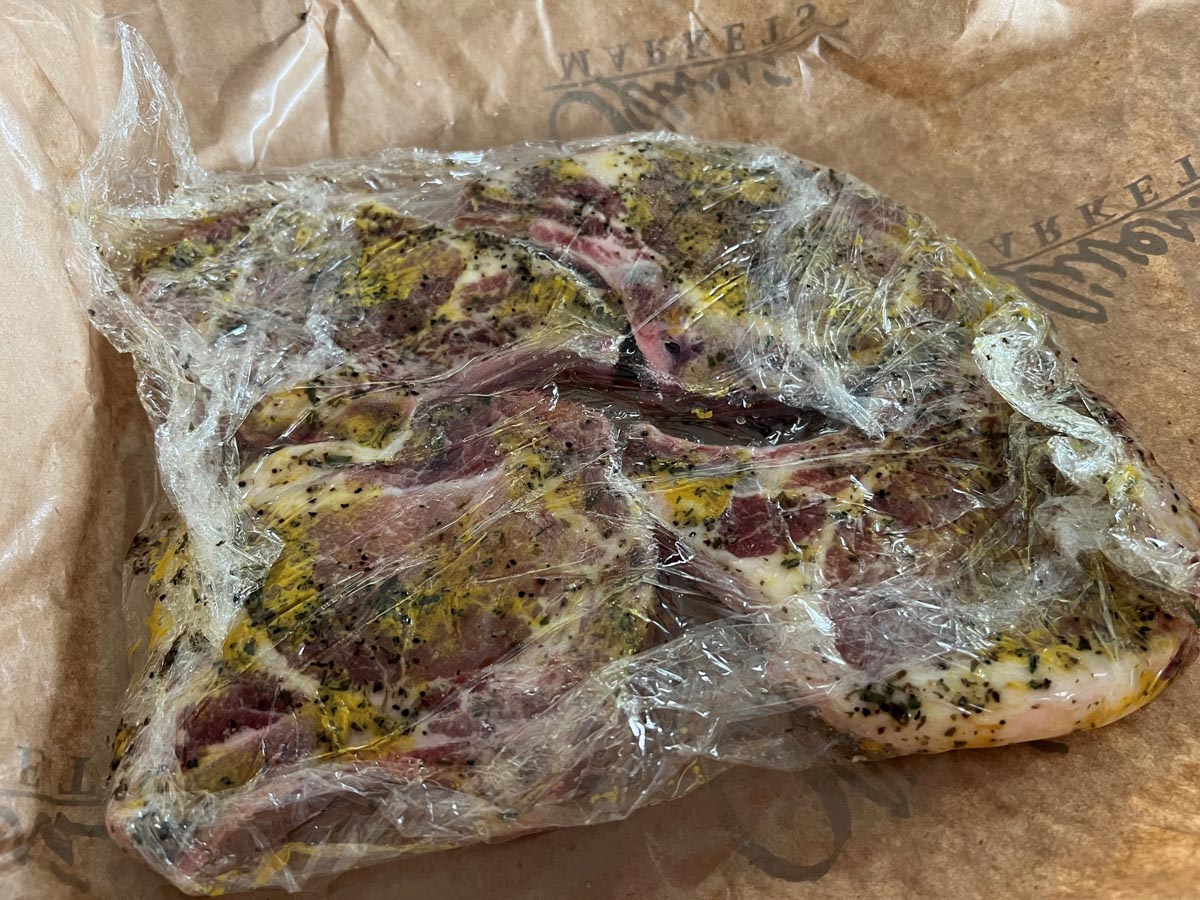
24 hours in advance, I marinate the chops in:
Olive oil
Garlic powder
Salt and Pepper
Droplets of French’s Mustard
Tarragon flakes
The mustard and tarragon work together like a well-rehearsed church choir – a beautiful unison of flavors and vocal sounds!
For process, I put the olive oil down first, then the garlic, black pepper, and a limited amount of mustard, and lastly the tarragon.
Importantly, I salt each side of the chops before I lay them into the marinade, then turn them over and smear them around the bottom of the plastic wrap. You can use a Pyrex dish or some other vessel, but I use large sheets of plastic wrap because I can just discard the wrap once I start cooking, versus cleaning another dish.
Once the chops look evenly smeared (a technical cooking term!), I cover them with another sheet of plastic, seal the edges, then refrigerate until the next day.
Remove from fridge about two hours prior to cooking, so get them room temp.
For cooking!
Place a large, preferably stainless skillet, on the stove and turn heat up to high. You can use cast iron skillet or even a Teflon skillet, though you may not get the same golden-brown coloring to the fried chops.
Once the skillet is good and hot, drizzle in a little canola or peanut oil (it burns less at high heat, than olive oil), and drop the chops in once at time, searing each side for only 90 seconds. Once you flip to the second side, and after 90 seconds, turn stovetop off and let the chops rest while you plate the sides or toss the salad.
Serve the chops, then drizzle a little of the remaining juices and oil onto each chop.
I had a friend over and we drank a bottle of Cabernet Franc with the meal. It was perfect!
It may be a stretch to call any meal “the perfect meal,” but that was my thought when I pushed this platter to the side, empty.
It was so straight-forward, with texture and full, complimentary flavors, but not in an overwhelming way – the way some really great food is.
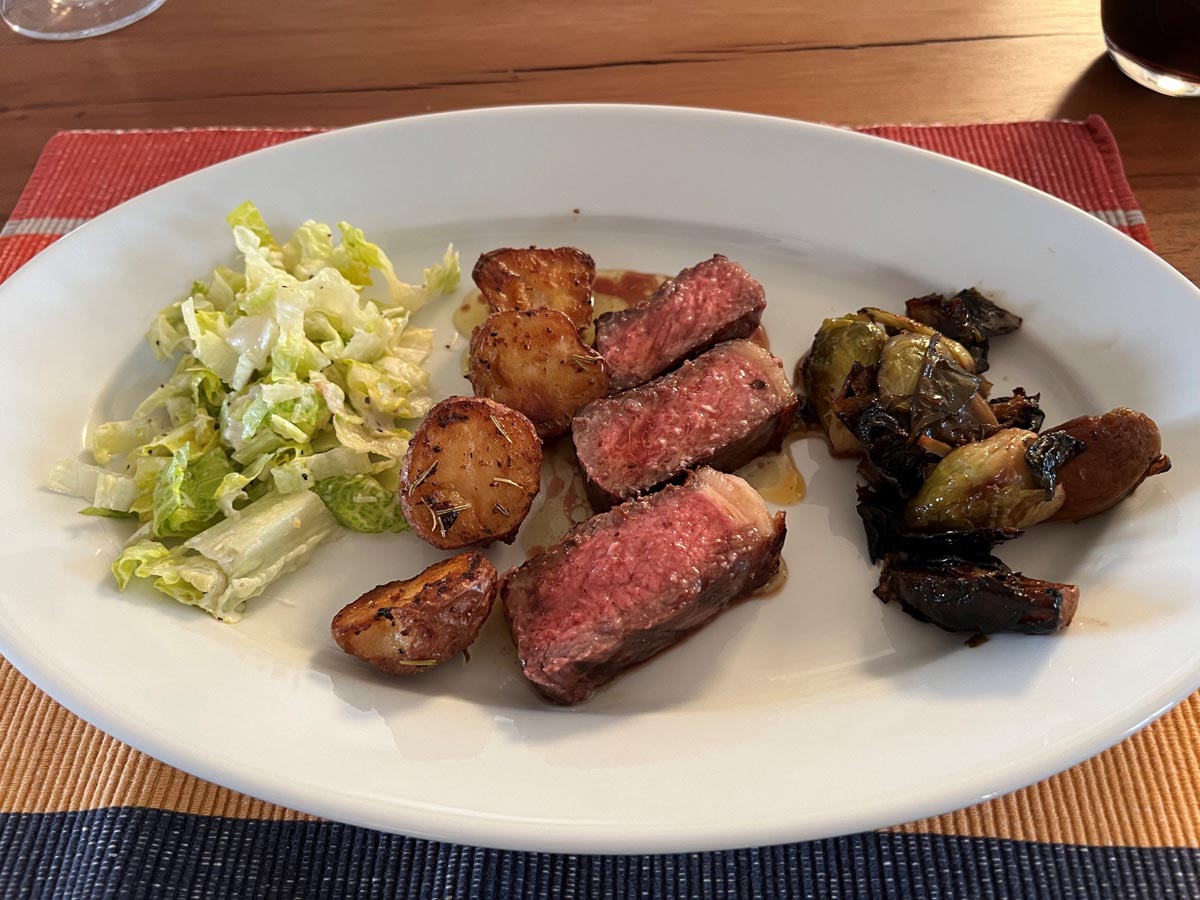
It was such an American meal! Steak and potatoes down-the-middle. Perfectly grilled New York Strip, creamy, rosemary and garlic red potatoes roasted just so, lightly dressed Caesar salad (homemade dressing) and New Orleans (hot and tangy) Brussell Sprouts. The contrast of the blackened sprouts (with Mongolian Chile oil and sunflower oil) and finished with butter and generous splashes of red wine vinegar sets off the steak bites and freshness of the salad.
Each of the servings were on the small side, which was plenty to eat and satisfying.
This meal goes with any of the full-bodied reds from Bordeaux or a big, juicy Syrah. We enjoyed a 2018 Merlot from Lambert Bridge.
It was one of those springs we just couldn’t shake. A warmish day yielded to cold and wet the next one, followed by a dry but cloudy day and some wicked Spring winds carried south from the Pacific Ocean’s Alaska-to-California current that cool our usual “sun-kissed valley,” a charming phrase coined by Jack London to describe what is now known as Silicon Valley – where the epic story begins in his book, The Call of the Wild. Whether London was ever in the Santa Clara Valley or not (my guess is he was), he wrote the book while living one valley east of me, in the glorious and stunningly beautiful Valley of the Moon. And that valley is, indeed, sun kissed.
Anyway, “the Spring that wouldn’t quit” drove me to planning a comfort food dish that I hadn’t made all winter, and we had it for Sunday dinner: lamb shanks.
I’ve roasted plenty of shanks in the past, yet I reached out to my good friend on the East Coast, Owen, for any ideas. Owen is a serious home chef, like me, and I trust him implicitly and explicitly with our favorite passion, food. He sent me a clip from Chef John and his site, Food Wishes.
This dish was as easy to make as it was delicious. I usually don’t cook with recipes but I tried to be faithful to this one, and it worked! The meat was fork tender and crazy good! Even non-lamb eaters might like it, though at my age I’m not taking chances (and not wasting one of these hunks of meat on a potential convert).
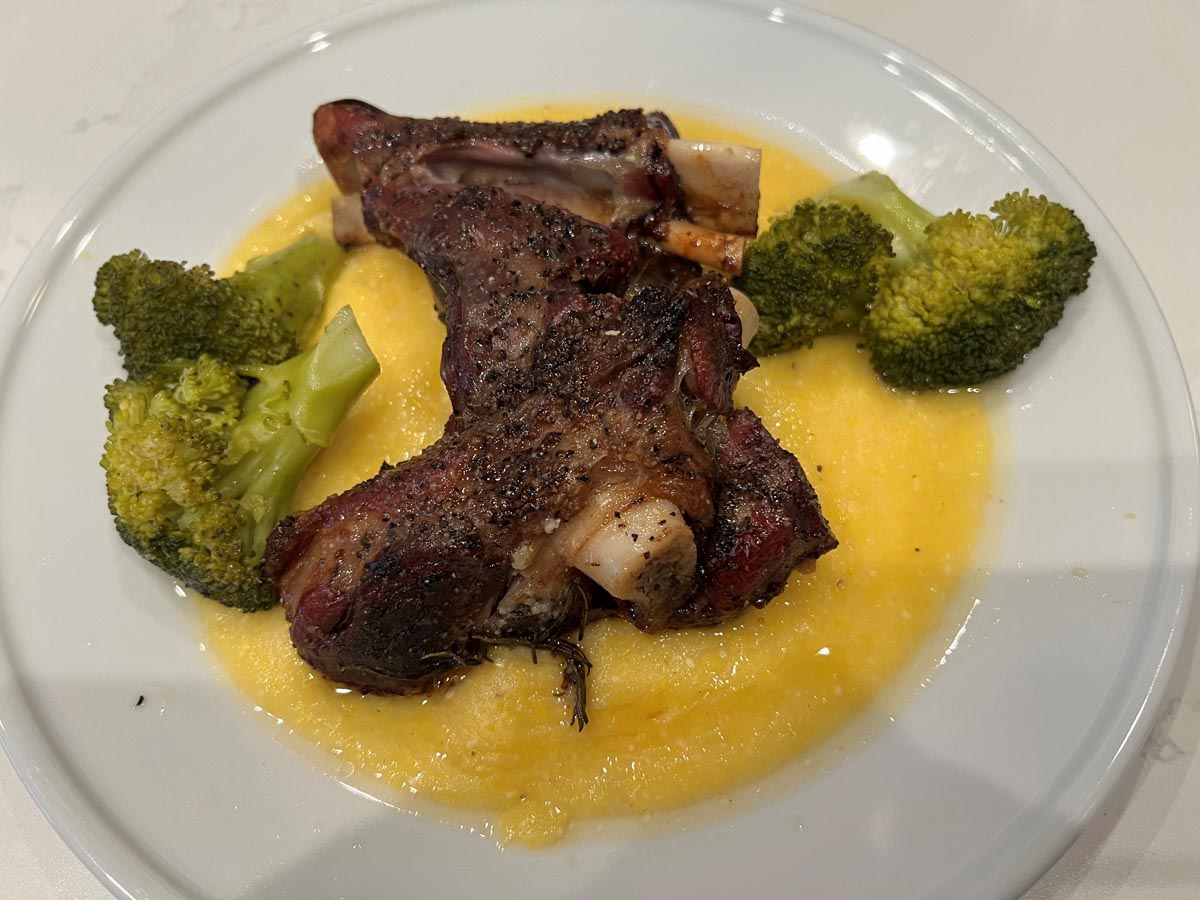
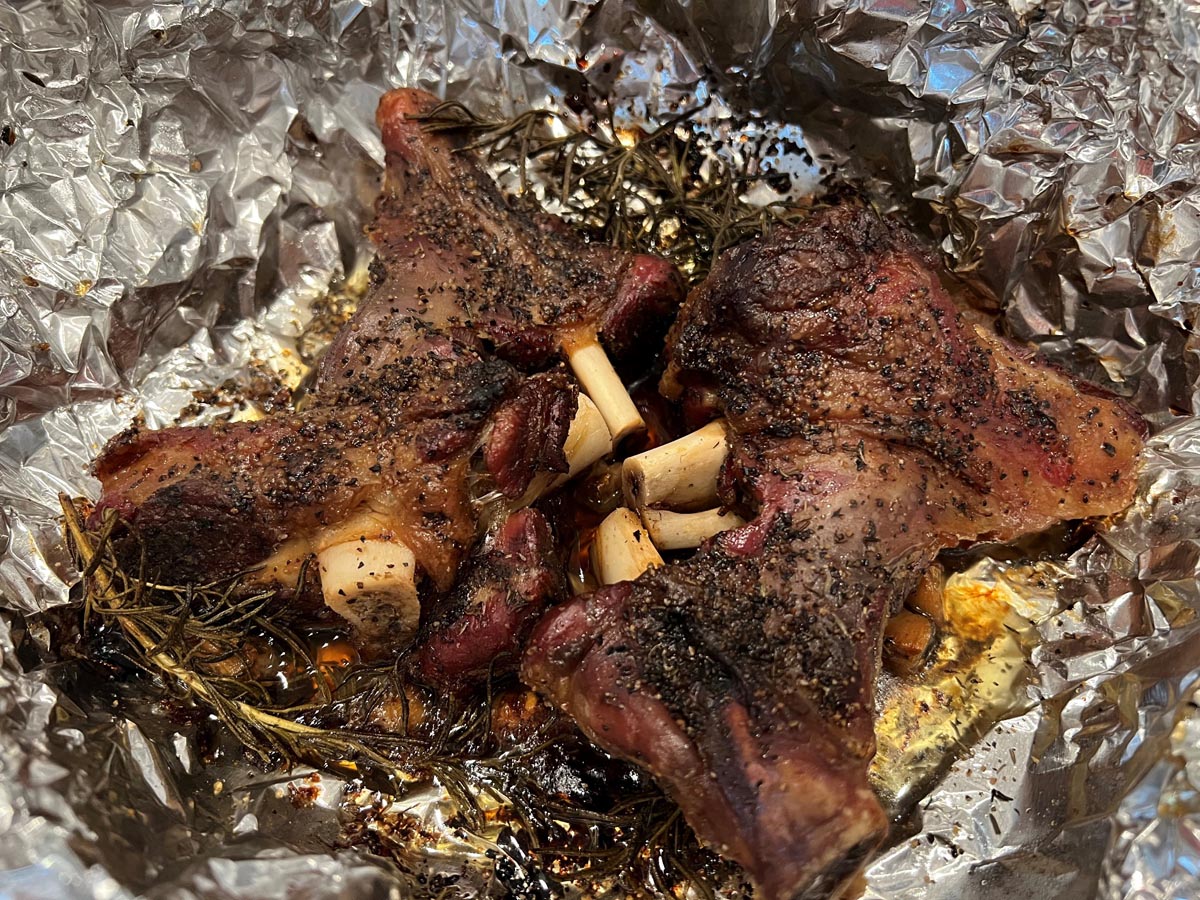
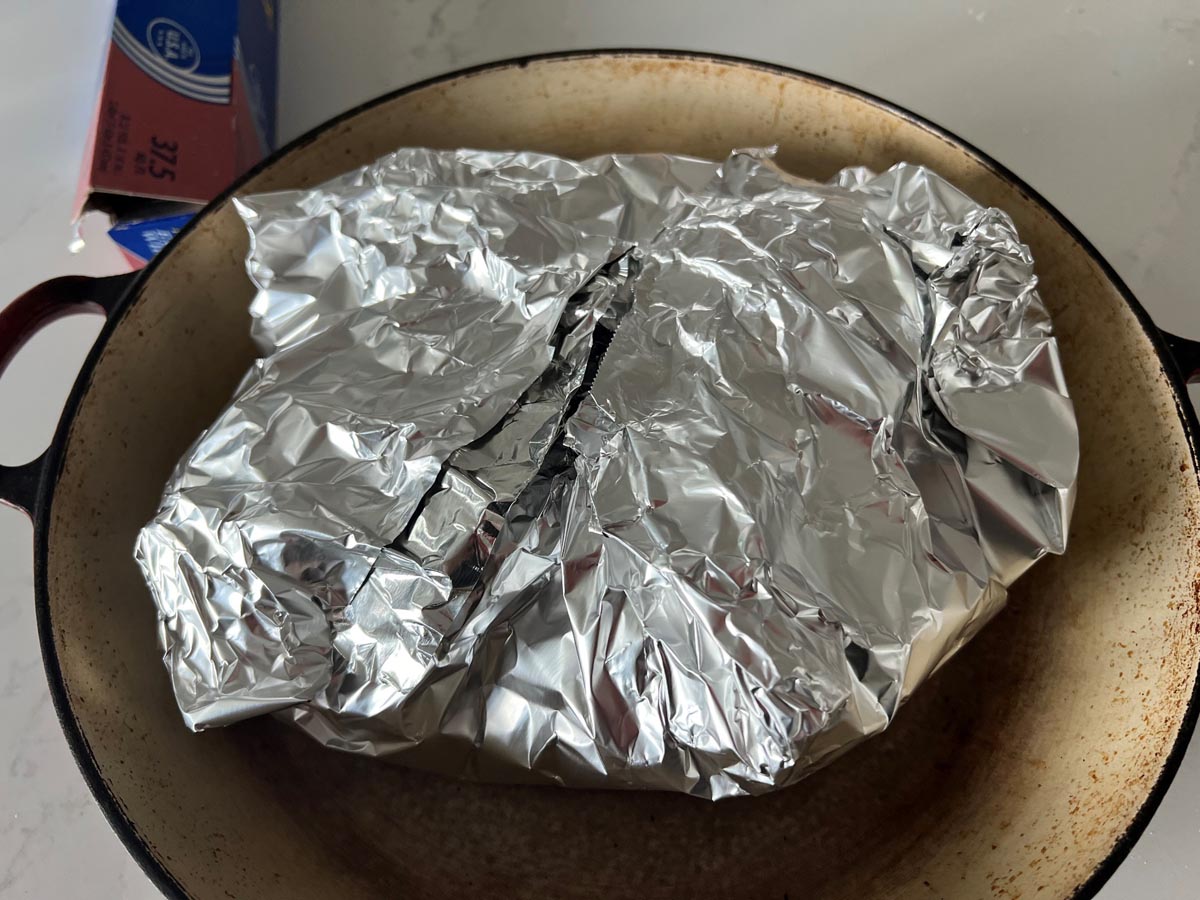
In a shallow roasting pan (I used my 4-quart Braiser from Le Creuset) lay down a large sheet of foil and put the shanks in, then generously salt both sides and also add black pepper. Roast them first, with nothing else in the pan, at 450 for about 40 minutes, until they are golden brown. The photo here is what happens after step 2, which is to add a dozen or so garlic pieces and fresh rosemary, then double wrap the meat and flavorings in foil and slow roast at 275 for about 3 hours. This is what the shanks looked like after I opened the foil.
Chef John served his shanks over a bowl of bean ragout, though I went with our favorite winter carb, creamy polenta, with steamed broccoli.
We drank a 2022 Petit Verdot, “Fence Line,” from Merriam. It’s in the Russian River Valley AVA, just up the road from where we live.
We still had to wait a couple of weeks until we got consistent California spring weather, yet this meal made the wait a lot more tolerable.
Doesn’t everyone remember the first time they went to New York City? I mean, the Big Apple, the inspiration of a Frank Sinatra song for the ages!Since this is a food blog, and about New York, we included a riff from another classic tune of the 20th Century, Billy Joel’s 1977 hit from his LP The Stranger, Scenes from an Italian Restaurant (‘in our Italian restaurant’). Never mind that I grew up Italian, those are some of the coolest lyrics (and music!) from my generation. Yesterday, on my weekly grocery run, I bought a nice piece of Atlantic Salmon. A little fatty, the way I like it, and on sale at $15.99 per pound. The Atlantic Ocean is colder than the Pacific Ocean, near my home, and hence the salmon is typically fattier than what we get from the Pacific Northwest waters.
I had no forward intentions about dinner based on the salmon, but this morning, it came to me. I would replicate a salmon and pasta dish I had in New York on my first night in the city. It was 1995 and New York at the time was transitioning from its gritty period during the 1960s and 70s. It’s hard to say, but disco and clubbing could have been instrumental in the city’s transition. Who can forget the 1983 release of (the Bee Gees) Staying Alive? Everyone remembers the movie’s star, John Travolta, though you would be hard-pressed to win a hand at Trivia to answer the question: who wrote the screen play? Sylvester Stallone! Rocky wrote it with Norman Wexler.
I was in New York for a job interview. It turns out, that was a transformative and seminal moment for me. I did seven interviews in one day and caught the evening flight back to San Francisco. A few days later, I got the word: I had the job. That job changed everything for me. I was in my mid-30s and had finally stumbled upon a career. Three decades+ later, that career, still going, became very fulfilling and lucrative (enough). Gratitude comes to mind.
The one-and-only night I spent in New York City on that trip was the night before the long day of interviews. I arrived in time for a walk before dinner, not knowing where I was per se, or much about the city. The company, at the time located on 52nd Street in Midtown Manhattan, had put me up in a business-class hotel not far from their headquarters. I walked the neighborhood, learning that a stretch of 52nd Street was a center of jazz performance from the 1930s to the 1950s.
An hour or so into my walk, I started getting hungry and began taking a closer look at the restaurants I passed. I would try the first one that caught my fancy.
Before I found the restaurant, a modest Italian joint (name long-ago forgotten) with (no kidding) red-checkered tablecloths, I passed a couple of black women dressed like prostitutes. Because they were. The larger one of the two – she was big but not fat, pretty, and with all the curves in the right places. She wore a snug-fitting red dress and solicited me. I was shocked, having never met a prostitute, and her suggestions for the next hour of my life made my head race.
Paul Simon’s lyrics come to mind, “I do declare there were times when I was so lonesome I took some comfort there – la la la la la-la.” First time for everything, I thought.
Then I had a conflicting moment, and imagined that the ladies were plants, and the company I was about to interview with was testing my moral character, watching what was about to go down. In hindsight, I’m pretty sure that thought of precaution was why I declined the offer from the lady in the red dress.
Karma’s a funny thing, and who knows, had my temptation succumbed, I may not have got the job offer.
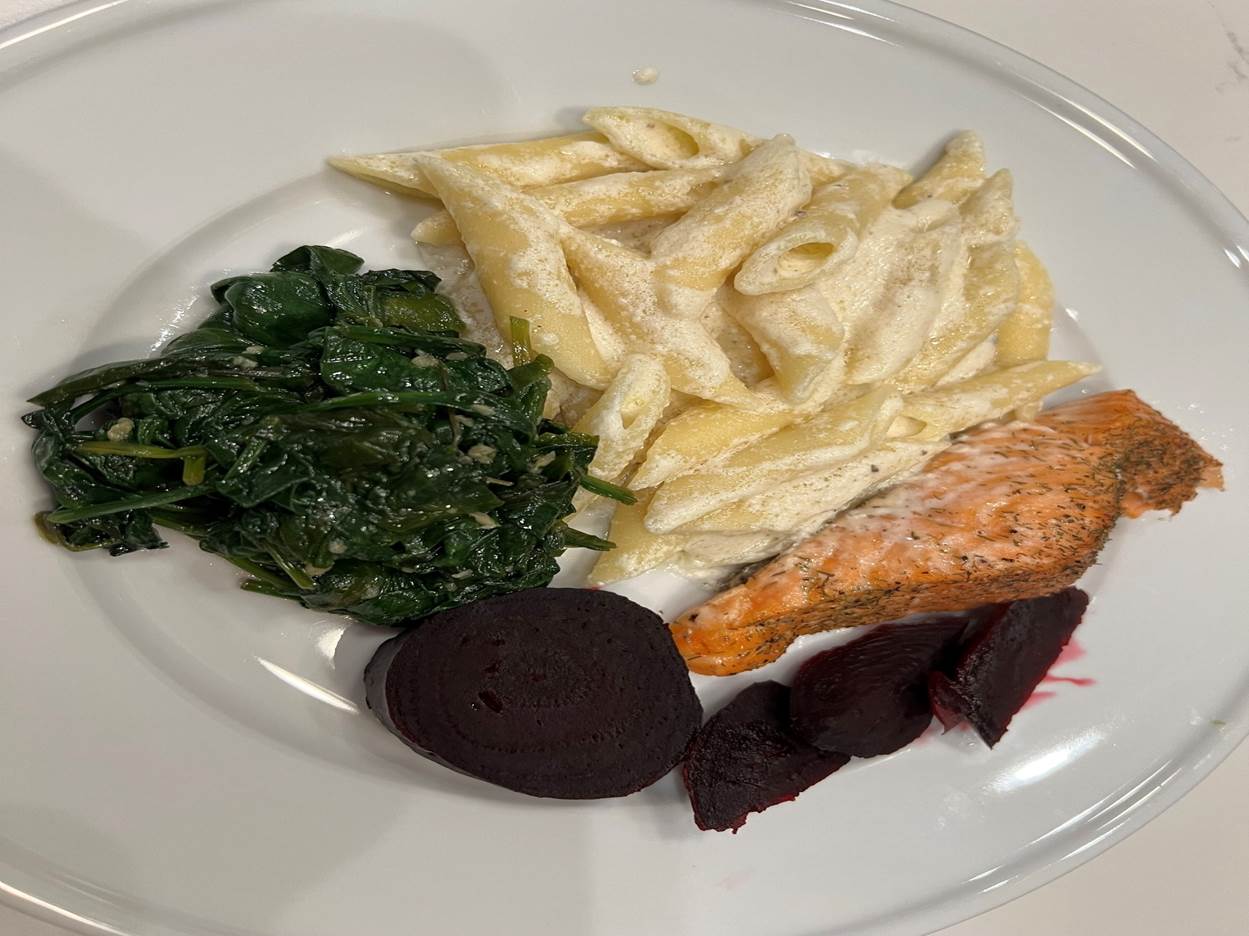
That night I dined solo on a salmon and pasta dish, with a side of sliced, warm beets, and serving of fresh spinach lightly sauteed in olive oil and garlic. The salmon was roasted with light seasonings, the pasta in a cream sauce that was perfectly prepared, not too-thick or too-rich as it could overwhelm the simple deliciousness of freshly caught roasted salmon. The sides were a delightful complement, especially since I had rarely eat beets.
Notes on the cooking
I make my white sauce with a classic butter roux, with a twist; I add in a couple heaping tablespoons of white truffle sauce I buy in cans from Urbani Truffle (in New York, where else!) and have them shipped to the house. The sauce includes butter, flour, parmesan cheese and half and half. I used penne pasta for my replica.
I cooked a couple of fresh red beets earlier in the day in boiling water. Once the beets had softened, I ran cold water in the pot (in the sink). After they cooled a bit, I removed the skins with a sharp knife. Then put them in the fridge until dinner, when I would slice them, then warm them (microwave or oven), and serve them unseasoned.
Roast the salmon skin down; after smearing some peanut oil on the bottom of the dish so the skin can be removed easily after cooking. Salt and pepper the top (lightly). Discard the skin, unless you have a dog or cat, and serve the same wedges on the same plate as the pasta and beets.
If the spinach is a little wet, drain it so its juices don’t mix with the main components of the meal.
I used four (4) medium-to-large sections of garlic (from a fresh clove), which I put through a garlic press in an extra-large skillet with a light amount of good olive oil. I started cooking the garlic without the spinach, yet before the garlic started to turn golden brown, I added a big tub of fresh spinach in batches, until my (deep) skillet was full, then drizzled a few tablespoons of water on it. Cover tightly, cook on medium heat for 5-6 minutes then turn the stove top off. Leave the lid on, unattended, for another 10 minutes. Remove lid, turn heat back on to evaporate some of the liquid and lightly salt to taste and a little more olive oil. That’s it. Serve all four dishes at once!
Wine
I had some ideas on what to pair with this meal, ranging from a Fume Blanc (too light, I thought) to a clean, stainless steel tank-fermented and non-oaky Chardonnay from Merriam Vineyards to a Pinot Noir or a Rhone varietal or blend. But first, I shot off an email to my wine rep at Kermit Lynch Wine Merchants in Berkeley, Bryant V. and asked for his thoughts once I sent him the menu and cooking notes. Now, I would trust this man with my dog and my truck if I needed someone to keep an eye on my valuables, so I had full confidence in his opinion. Wow, I was not disappointed!
Here it is
What would you pair with my dinner tonight?
Sounds delicious! My pairings to go with your meals:
Roasted salmon (lightly seasoned): (I would love a white Burgundy, perhaps a Macon Village if not a Sancerre for white, a light red Morgon or Liguria Rossese)
Penne pasta in a white truffle cream sauce (light on the truffle, but there) (You would want a white with a bit of richness, perhaps an aged Savinieres or Viognier like Condrieu. If not again a White Burgundy a safe choice that has a bit of neutral oak)
Fresh spinach in garlic and olive oil, sauteed (Chablis – especially a lean, unoaked style – Crisp, steely, and a natural match for greens. Muscadet – If you want something ultra-refreshing with a subtle saline touch. Or a lighter red like red Burgundy)
Warm beets sliced thin – (Saumur-Champigny) – Herbaceous, slightly peppery notes work beautifully with beets.
There you have it.
Just so happens, I had just returned from a leisure week in Hawaii and after putting in a long day at the desk, prepping dinner and doing laundry in between, I had a hankering for martinis, since you can’t enjoy them in the islands (too warm, the glass warms quickly). I had a couple while finishing the cooking. Bryant was right, a light red paired nicely. There was an unfinished bottle of Cotes-Du-Robles (aka Rhone) from Eberle (a 2021) in California’s Central Coast region (Paso Robles) on the shelf. It’s 54% Grenache, 38% Mourvèdre, 8% Syrah. It was just right.
The first time I served a steak to someone else, I was a couple weeks shy of my 13th birthday. A year earlier, while still 11, I got hired by the local Moose Lodge to be their Friday night dishwasher, when the members gathered for cocktails, grilled steaks and breaded, deep-fried fish, which was either catfish or halibut.
How I got that job, and ended up cooking for others at such a young age, is like a lot of life: it was unplanned, and just happened.
I was shooting hoops at the Boys Club when am man walked into the gym and bellowed: “Would anyone like to make ten bucks for two hours of work?”
There were only nine or 10 of us in the gym that night, with six guys playing a 3-on-3 half-court match and the rest of us practicing free throws or playing horse. I looked around, and when no one else raised their hand, I did.
Big Dave yelled, “Great, let’s go in and see Mike, and call your parents.”
Mike Bonner was one of the gym managers and apparently this fellow from the Moose Lodge, Dave, used the club to recruit dishwashers periodically, as most of the kids usually just did it for a couple months, then quit.
I was a budding entrepreneur since I was 10, mowing lawns, washing cars, helping neighbors clear out their garages, that sort of thing, and $10 for two hours of work was the equivalent of a massive pay raise. Bear in mind, in 1970 the minimum wage was $1.45 per hour, this night happened in December of 1969.
Once we were in Mike’s office, Dave asked Mike to call my parents, since he knew my father, who would drive me to the Boys Club, drop me off, then come and get me a couple hours later.
Dave asked me my name, and when Mike reached my dad and said hello, he then handed the phone over to Dave. Dave said to my dad: “Mr. Marsh, this is Dave from the Moose Lodge. We need a dishwasher for tonight’s grill and fish fry, and your son volunteered for the job. I’d like your permission to take him to the club and put him to work.
My father readily agreed and also to swing by the Moose Lodge around 9 p.m., as Dave promised him that I would be done by then.
I kept that job until my junior year in high school, some five years later.
The Moose Lodge cooks were themselves members of the Lodge. Big Dave was a dentist, and enjoyed his cocktails. His sidekick, Bill, was an accountant, and smoked cigarettes. The two men worked shoulder-to-shoulder during prime dinner time, from about 6 pm. to 7 pm., but otherwise took breaks to go out to the lounge and drink and smoke with their friends. Often, one of them would stay in the kitchen to manage orders as they trickled in. Toward the end of those Friday nights, it was common for both of them to be in the lounge.
At first, when a late-night order came in, one of them would return to the kitchen and make the meal – or two, for the members. After I had been there for many months, however, Dave started teaching me how to grill a steak, and how long the fish had to be in the fryer, as well as how to drop a fresh basket of fries.
I would be in the kitchen by myself, cleaning up cutlery, cutting boards, dishes, pots and pans, and suddenly I would hear Dave boom from the lounge: “Order up!”
And that’s how I ended up serving my first meal of grilled steak and fried fish with a side of fries to a grown up.
Fast-forward to the present, and readers to this blog know my strong preference for Snake River steaks, particularly, New Yorks and Ribeye’s, though lately I’ve been doing a stove-top, pan-seared Filet Mignon for a wicked-good Asian meal with jasmine rice and a large side of mixed vegetables (Bok choy, celery, red onion) fried with a light amount of sesame oil, sunflower oil, a few drops of fish sauce, a generous spoon of chili garlic sauce and finished with a nice sprinkling of ponzu sauce.
For food adventures, friends and family have joined me for some memorable meals at some of America’s best steak houses. Benjamin Steak House on 41 Street in New York, and Jeff Ruby’s Steakhouse in Cincinnati, come to mind.
But my recent Chicago steak house experience?
I have to stop embarrassing myself in restaurants, which also aggravates my partner – and no doubt embarrasses her, too. It’s not the usual thing about poor restaurant behavior – i.e., public intoxication. Rather, it’s my food snob snobbery and asshole attitude when things go awry.
The recent episode in Chicago has set my resolve to either, A. not go to certain restaurants where my disappointed is assured, if not guaranteed; B. go to the restaurant and order something that won’t disappoint me; or C. go to the restaurant, adjust my attitude, that it’s about the company etc. and don’t complain about the food.
The incident in Chicago, at one of the city’s most popular steak houses, for example, I could have ordered the Chilean Sea Bass, which is pretty much good anywhere. But no, we were there for the steak.
After careful consideration, we settled on the St. Louis cut – a bone-in New York strip.
It was cooked perfectly medium, medium rare, the way we like it. But it was flavorless, and dry.
I don’t remember which wine I ordered because my behavior after the first few bites of steak blurred the rest of the night.
When the server – who was very engaging, cheerful and could not have been nicer, came around to ask how the steaks were, I looked at him without any sort of facial expression or projection, and said without menace. “It’s dog food.”
Taken aback, the server said: “What?”
“It’s dog food,” I said again.
The server and manager swung in to action to resolve the matter and cooked a fresh, different cut of steak. They even swept away the sides to bring fresh sides with the fresh steak (asparagus, mushrooms, and probably the best onion rings in the world).
And they brought me a fresh martini, on the house, which was ice cold and filled to the brim flipping perfect.
Seeing the expression on my partner made me remorseful. The night had started so pleasantly, and here I was, acting The Dick!
The second round of steaks and sides were more or less the same, and I acted like the meat was much improved. When I settled the bill, I left a ridiculously large tip.
So, there you have my resolve and resolution for future dining in American cities.
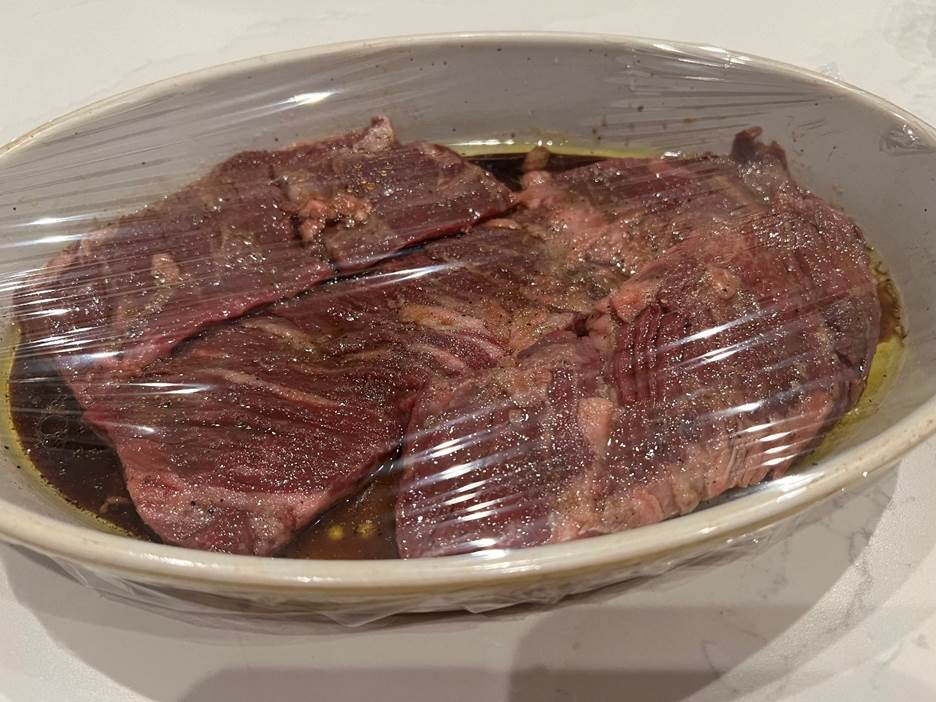
Meanwhile, back home a couple weeks later, I marinated a wonderfully affordable cut of beef, skirt steak (pictured above).
This meat is tender and full of flavor!
The marinade
In a large casserole dish, add:
Enough good olive oil to nearly cover the entire bottom
Sprinkle garlic powder evenly throughout
Black pepper, the same
Fish sauce – add drops here and there throughout the dish
Terriyaki marinade sauce, the same.
Lemon – squeeze the juice of one lemon, throughout
Salt each side of meat before laying them into the casserole dish, and turn them over
Cover tight with plastic wrap and refrigerate over night
Remove them from fridge the next morning, and turn them over in the sauce, cover and refrigerate again
Remove them from the fridge 2-3 hours before cooking
Pat dry with paper towel, but don’t dry them all the way.
I’ve cooked this inside on a hot steel skillet and they are good, but not as good as grilled on my Weber, with charcoal.
Once grilled, let the steaks rest for 10 minutes, cover them loosely with foil, then (using kitchen scissors), cut them along the grain into half-inch to three-quarter inch slices, serve.
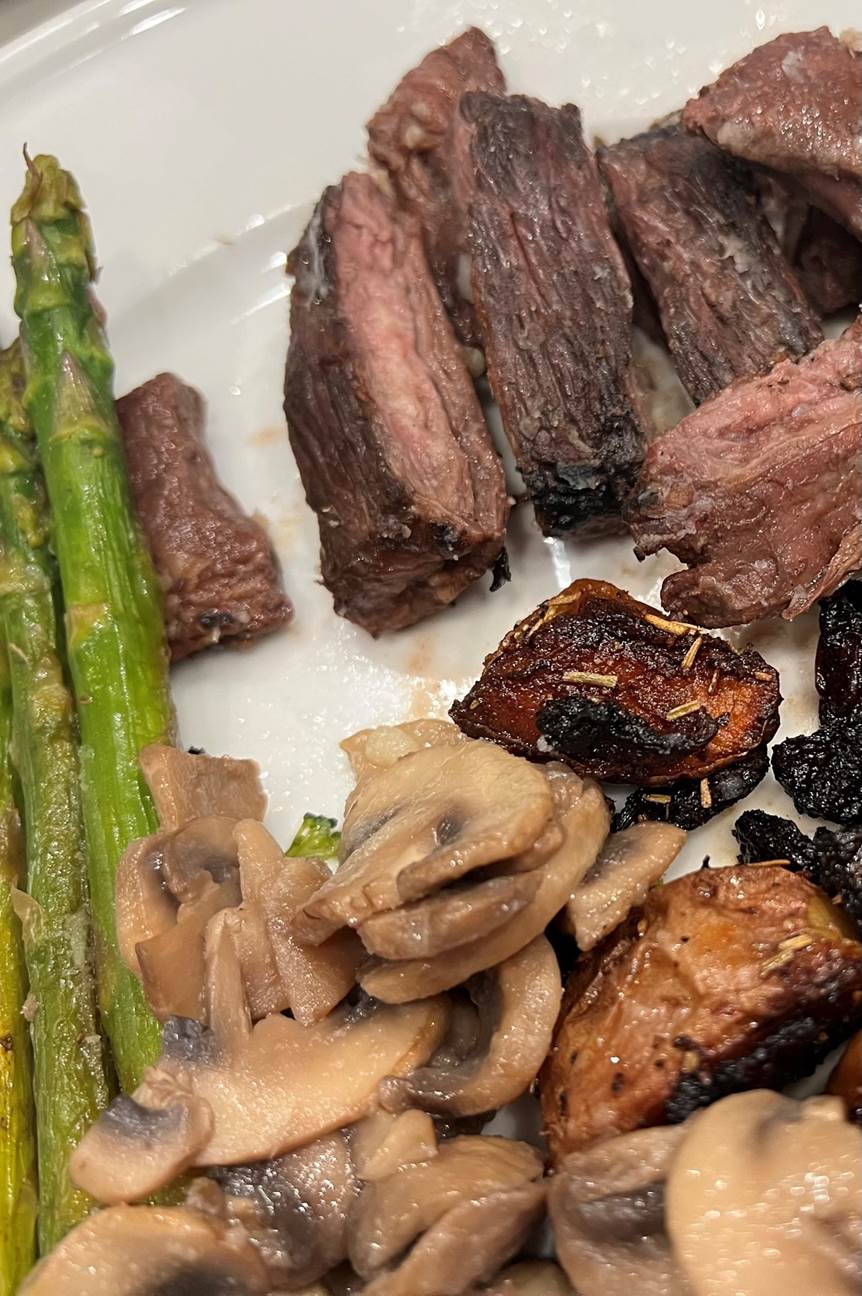
Serve with sides of your choice, though roasted potatoes, asparagus and mushrooms for mushroom lovers makes for a fine meal.